
As temperatures start to fall and the evenings get darker, many households across the UK begin thinking about lighting their wood-burning stoves and fires again.
One question we regularly hear is: how much firewood do I actually need to get through winter?
Unfortunately, there isn’t one answer that works for every household. How much firewood you use will depend on your stove, the size of your home, how frequently you light the fire and whether you’re using your wood burner as an occasional source of extra warmth or as a significant part of your home heating.
At Lightning Logs (Taybridge UK LTD), we supply quality kiln-dried firewood to help customers stay stocked up and prepared for the colder months.
Here’s what you should consider when estimating how much you’ll need.
How Often Do You Use Your Wood Burner?
This is probably the biggest factor affecting how much firewood you’ll get through.
Someone who lights their stove for a few hours on Saturday and Sunday evenings will naturally use considerably less than a household running a wood burner every evening throughout autumn and winter.
Think realistically about your routine.
Are you likely to use your stove:
- Occasionally at weekends?
- Several evenings each week?
- Every evening?
- For long periods throughout the day?
Your usage pattern provides the best starting point when deciding how much firewood to order.
Occasional Wood Burner Users
If you mainly use your stove to create a cosy atmosphere on colder evenings, you may not need a huge winter stockpile.
Ordering a smaller quantity allows you to monitor how quickly you’re getting through the logs before ordering more.
However, it’s still worth keeping a reasonable supply available. When the first particularly cold spell arrives, demand for firewood can quickly increase.
Regular Evening Users
Many households light their wood burner when they return home from work and keep it burning throughout the evening.
If this sounds like you, you’ll naturally require a larger and more consistent supply.
Instead of waiting until your log store is almost empty, it can make sense to stock up before the coldest weather arrives.
Having enough dry firewood ready to use means you’re not constantly worrying about your next order.
Heavy or Daily Wood Burner Users
If your stove plays a significant role in heating your home, your firewood requirements can be much higher.
Daily use over several months can consume a substantial amount of timber, particularly during prolonged periods of cold weather.
For regular users, buying larger quantities can be more convenient because it reduces the frequency of deliveries and ensures you have a good supply available when temperatures fall.
The important consideration is whether you have suitable dry, ventilated storage available.
Your Stove Makes a Difference
Not every wood-burning stove uses fuel at the same rate.
The size, design, efficiency and heat output of your stove can all affect how quickly you burn through logs.
A larger stove operating at a higher output will generally consume more fuel than a smaller appliance being used to heat a compact room.
How you operate the stove matters too.
Rather than trying to estimate your entire winter requirement based purely on the size of your property, pay attention to your actual consumption when the stove is running normally.
This will give you a much more useful indication of how much you’re likely to need.
The Type of Wood Matters
The species of firewood you’re burning can also affect the experience.
Different hardwoods have different characteristics, including density and burning behaviour.
At Lightning Logs, our firewood range has included popular hardwoods such as:
- Birch
- Alder
- Ash
- Oak
- Beech
- Hornbeam
Some denser hardwoods can provide a longer burn, while other woods can be useful when establishing a fire.
Choosing quality logs suited to your stove can help you get the best from every load.
Why Kiln-Dried Logs Matter
It’s not just the quantity of firewood that matters – the condition of the wood is extremely important too.
Wet logs can be difficult to burn effectively and can produce more smoke while providing poorer combustion.
Quality kiln-dried firewood has had its moisture content reduced, helping it burn more effectively when used correctly in a suitable appliance.
Rather than simply buying the largest possible quantity of logs, focus on having a dependable supply of properly dried firewood.
How Can You Estimate Your Winter Firewood Requirement?
One of the easiest approaches is to monitor your own consumption.
For example, track how much firewood you use during a typical cold week. You can then use this as a rough guide for the rest of the season.
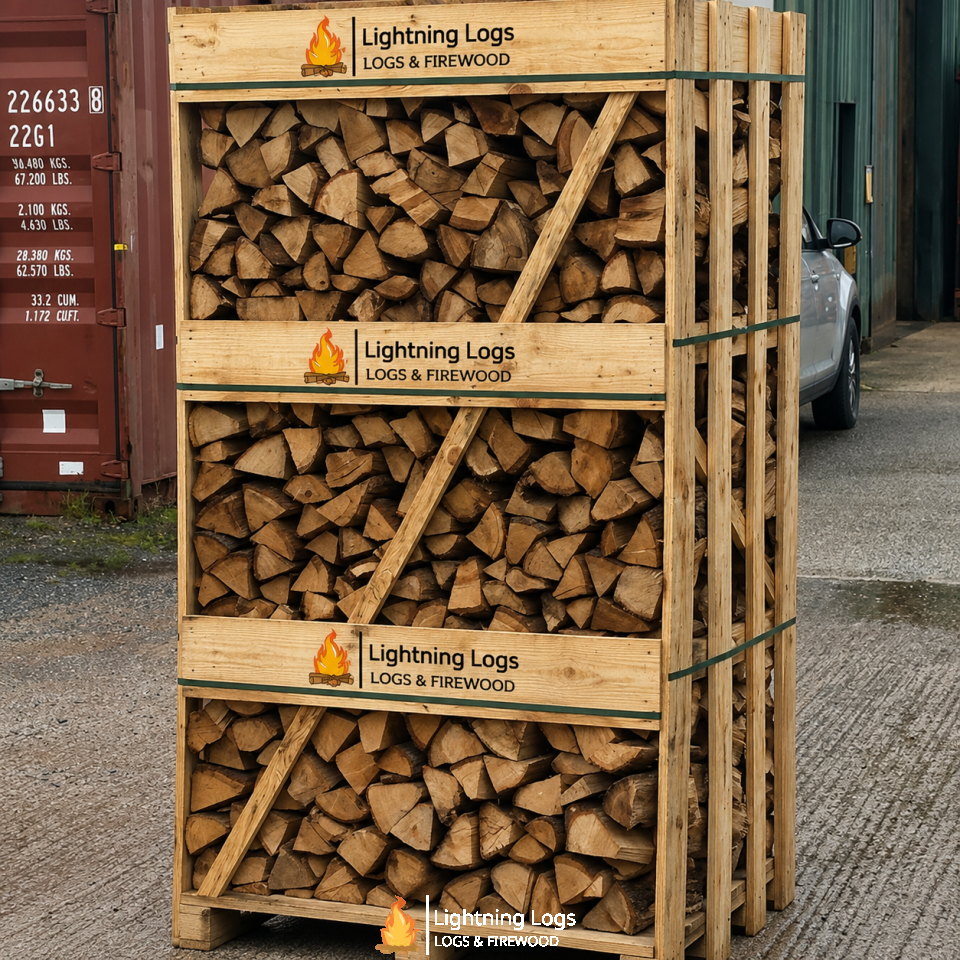
If your household gets through a particular number of bags, nets or crates each week, multiply that by the number of weeks you expect to regularly use the stove.
Remember that your consumption is unlikely to remain exactly the same.
A mild November could require relatively little firewood, while a particularly cold January may see you lighting the stove earlier and keeping it running for longer.
It’s therefore sensible to allow some flexibility rather than estimating down to the final log.
Should You Buy Your Winter Firewood in Advance?
If you have suitable storage, stocking up before winter can be a convenient option.
It means you have logs ready when you need them and reduces the risk of suddenly discovering you’re running low during a cold spell.
Autumn is a particularly good time to check your existing firewood supply.
Take a look at your log store, think about how frequently you used your stove last winter and decide whether your current stock is likely to be enough.
Store Your Logs Correctly
There’s little benefit in purchasing quality kiln-dried firewood and then storing it somewhere unsuitable.
Firewood should be kept protected from excessive moisture while still having appropriate airflow around it.
A purpose-built log store can work well, particularly when it keeps logs raised away from wet ground and provides ventilation.
Avoid simply leaving firewood exposed to rain throughout the winter.
Good storage helps keep your logs in suitable condition until you’re ready to use them.
Don’t Leave It Until the Last Minute
Firewood is one of those winter essentials that’s easy to forget about until you go outside and realise your log store is almost empty.
Checking your supply early gives you plenty of time to prepare.
Whether you’re an occasional weekend user or someone who relies heavily on a wood burner throughout winter, having a suitable quantity of quality logs ready can make the colder months much easier.
Stock Up for Winter with Lightning Logs
At Lightning Logs (Taybridge UK LTD), we supply quality kiln-dried firewood for customers looking to keep their homes warm and their log stores stocked throughout the colder months.
With a selection of hardwood options available, we can help you choose a suitable supply based on your requirements.
The amount you’ll need ultimately depends on your individual usage, but one thing is certain – it’s better to check your firewood supply before the temperature really starts to drop.
🔥 Getting ready for winter?
Contact Lightning Logs (Taybridge UK LTD) today to discuss your kiln-dried firewood requirements and get stocked up for the colder months ahead.


